Strength Training for Women Over 40: Why It Is the Best Use of Your Time
Why lifting is the highest value exercise in your forties, the bulky myth handled honestly, and exactly where to start if you are new or coming back.
 By Luke Robinson, personal trainer in Cuckfield · 8 min read
You are in your forties, you are busier than you have ever been, and something has quietly shifted. The scales might not have moved much, but your clothes sit differently, the stairs with the shopping feel like more of an event, and the exercise that used to work does not seem to do a great deal any more.
This is the most common conversation I have with women who come to see me. Almost none of them arrive wanting to lift weights. Most of them arrive wanting to feel like themselves again. Strength training happens to be the fastest route there, and it is the single highest value form of exercise available to you in this decade of your life. Here is why, and here is how to start without spending six months guessing.
Why your forties are the decade strength matters most
From your thirties onwards, muscle mass declines gradually unless you give your body a reason to keep it. The process is not dramatic year to year, which is exactly why it creeps up on people. You do not notice it in a month. You notice it a decade later, when carrying both shopping bags in from the car in one trip stops being automatic.
Muscle is not really about looking a certain way. It is the tissue that keeps your metabolism ticking along, it is what supports and protects your joints, and it is what decides whether the ordinary physical demands of your life feel easy or hard. Bone works on a similar principle. Put a meaningful load through the skeleton regularly and it has a reason to stay dense. Avoid loading it and it does not.
Your forties are also, for many women, the decade when perimenopause begins, when sleep becomes less reliable, and when work and family demands are at their absolute peak. All of that makes it tempting to do less. It is the wrong instinct. Strength work pays back harder per hour than anything else you could do, and when hours are the thing you do not have, that is the only measure that counts.
The bulky question, answered honestly and then dropped
You will not accidentally get bulky. Building large amounts of visible muscle is slow, deliberate, specific work that takes years of dedicated training and eating to achieve on purpose. Nobody has ever woken up bulky by mistake after three months of training twice a week.
What actually happens when women lift consistently is that they get denser, stronger and more capable. Body shape usually changes in the direction people were hoping for, because muscle takes up less room than the same weight of fat and holds everything in a more athletic shape. If you feel a bit fuller in the first fortnight, that is almost always temporary swelling in the muscles responding to unfamiliar work, and it settles down.
That is the entire answer, and I am not going to give the myth any more airtime than that.
Where to start if you have never lifted, or have not in years
That is what the free consultation is for. We talk through your goal, your history and what would realistically fit your week.
Start with a small number of movements, done properly, repeated often enough that you actually get good at them. The mistake I see most often is variety for its own sake. Twelve different exercises done once each teaches your body nothing. Five exercises done every week for three months genuinely changes you.
The patterns I would build a first programme around are these:
- A squat pattern. Goblet squats, holding a single weight at your chest, are the easiest way in. They teach the whole shape of the movement and they are hard to do badly.
- A hinge pattern. Romanian deadlifts or hip thrusts. This is where your glutes and hamstrings live, and it is the pattern most people are weakest in, because a day spent sitting at a desk does nothing to train it.
- A push. Press ups with your hands raised on a bench to start with, or a dumbbell shoulder press. Both are fine. The raised press up is not a lesser version, it is the right version for now.
- A pull. Rows of some kind, with a dumbbell, a cable or a band. Pulling work does more for your upper back and the way you carry yourself than any amount of stretching.
- A carry. Pick something heavy up and walk with it. It is the least glamorous exercise on the list and it builds grip, trunk strength and general robustness better than almost anything you could swap it for.
Two sessions a week built around those patterns, done for real, will take you further than five scattered classes. Three is better if you genuinely have the time, but two done for a year beats three done brilliantly for a fortnight and then abandoned.
What to prioritise, in order
- Consistency first. The best programme is the one that survives a full diary, a sick child and a work trip. Everything else is a detail by comparison.
- Technique second. Learning to hinge properly is worth more than adding ten kilograms this month, because good technique is what lets you add a great deal more over the next three years without getting hurt.
- Progressive overload third. Your body only changes if the demand on it goes up over time. The same weights forever means the same body forever.
- Protein fourth. Most women I meet eat noticeably less of it than would help them. Holding on to muscle and building it needs the raw material, and spreading it across the day rather than saving it all for dinner tends to work better.
- Sleep and stress fifth. By fifth I do not mean unimportant. I mean it is the one you have the least direct control over, so do not let a rough patch of sleep be the reason you never start.
How heavy is heavy enough
Heavy enough that the last two or three repetitions of a set are genuinely hard and starting to slow down, but not so heavy that your technique falls apart. If you finish a set of ten and feel like you could comfortably have done another ten, that was a warm up, not a working set.
This will feel uncomfortable at first if you have come from classes where the weights were fixed and light. It is also where most of the benefit lives. You do not need to train to absolute failure and you should not be leaving every session wrecked. You need to work hard enough that your body has a reason to adapt, then come back and do slightly more next time. That is the whole game, repeated for years.
The things that make it stick
Almost anyone can train hard for three weeks. The women who genuinely change are the ones who build something that survives a bad month. A few things that help:
- Fixed times in the diary rather than good intentions. Tuesday and Thursday at seven beats twice a week whenever I can, every time.
- Write down what you lifted. Memory is unreliable and the log is the only thing that tells you honestly whether you are progressing.
- Have a short version ready. Twenty minutes covering a squat, a hinge and a pull is a real session. Doing that on a rough week is how the habit stays alive.
- Expect the first month to feel clumsy. Coordination is a skill and skills take repetitions. Feeling awkward is not evidence that you are bad at this.
If you want a sense of how I structure that in practice, I have written about how coaching works and what the first few weeks usually look like.
Does this mean giving up cardio and walking
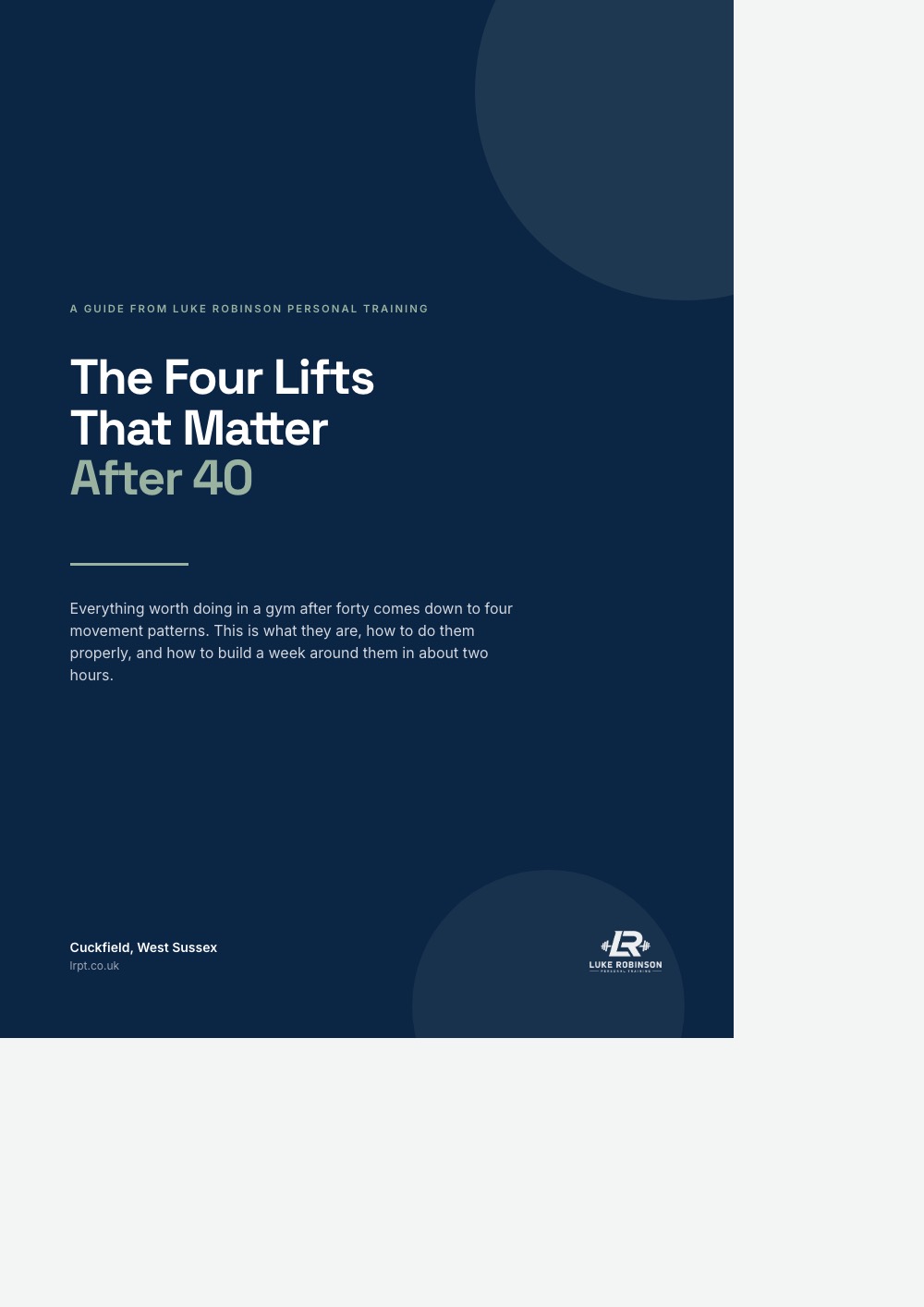
Two free guides, no charge
The four lifts that matter after 40, and how to eat for strength without weighing anything.
Read them freeNo. Walking is excellent for your general health, your head and your recovery, and I would happily see you doing plenty of it. It just does not do the job that strength training does. Walking is not a strong enough stimulus to build muscle or to load your bones meaningfully, because your skeleton has been carrying your body weight around for forty years and is not remotely challenged by more of it.
So keep the walking, and keep any running, cycling or swimming you enjoy. Add the strength work on top, because that is the actual gap in most people's weeks.
You are not behind and it is not too late
Beginners and women coming back after ten or fifteen years away are my normal client, not the exception. Nobody is expected to arrive knowing what they are doing. The first sessions are deliberately about learning the movements with weights that feel almost too easy, so that your body gets to rehearse the pattern before we ask anything serious of it.
Progress at the beginning is genuinely quick, quicker than at any later point, because everything is new and your nervous system is learning fast. That surprises people. Three months in, women who described themselves as unathletic in our first conversation are lifting weights they would have called impossible in week one. Nothing magic happened. They just turned up and added a little each time.
If you are in Cuckfield, Haywards Heath or Balcombe and you would like to talk it through properly, the first step is a free consultation with no obligation attached. We sit down, you tell me what your week actually looks like rather than what it should look like, and I tell you honestly whether I can help. You can read a bit more about training with me in Cuckfield, or just get in touch and we will find a time that suits you.
Training in Cuckfield, Haywards Heath or Balcombe? Book a free consultation and I will give you a straight answer about what would work for you.
Book your free consultation