Most people are a bit nervous before a first session. Usually it is some version of the same worry: that they are not fit enough to start, or that they will be pushed until they are sick.
Neither is how a good first session works. Here is what actually happens.
It starts with a conversation, not a session
Before anyone trains with me there is a free consultation. It is a proper conversation about what you want, what you have tried, what your week actually looks like, and anything going on with your body that I need to know about. It is also your chance to work out whether you want to be coached by me, which matters more than people realise. You will be spending a fair amount of time with this person.
There is no obligation attached to it and there is no hard sell at the end. If you want to see the full picture before you get in touch, I have written out how coaching works from the first call onwards.
Before you arrive
You fill in a short health questionnaire. It covers injuries, medical history, medication, sleep and what you actually want to achieve. It is not a test. It is how I avoid giving you something that hurts you.
Be honest on it, including the parts you would rather skip. An old back injury you have stopped mentioning, a shoulder that clicks, blood pressure medication, a knee that has never been quite right since football. None of it stops you training. All of it changes which variation I start you on. If there is anything significant going on medically, or you have not exercised in a long time and you are unsure, have a quick word with your GP first and tell me what they said.
Practical things for the day itself. Eat something an hour or two beforehand, but nothing heavy. Do not turn up having skipped lunch and had four coffees. Arrive a few minutes early rather than sprinting in from the car, because the first ten minutes set the tone for the whole thing.
What to bring
Trainers you can move in, comfortable clothes, water. That is it.
You do not need special kit, lifting shoes, straps or a belt. Running trainers are fine to start with, though something flatter is better once you are squatting properly, and that is a conversation for later rather than an expense for now. Bring a towel if you sweat easily. Nothing else is required.
The first twenty minutes
That is what the free consultation is for. We talk through your goal, your history and what would realistically fit your week.
We talk, then I screen how you move. Squat, hinge, push, pull, and how your shoulders and hips behave. This tells me where to start and what to avoid. If your left knee does not like a certain angle, I want to know that in week one, not week six.
The screen is not a fitness test and you cannot fail it. I am watching things like whether your heels stay down in a squat, whether you can hinge at the hips without rounding your lower back, how your shoulders behave when your arms go overhead, and whether one side moves differently from the other. Most people have something. Almost nobody is symmetrical and nobody needs to be perfect before they are allowed to train.
I will also ask questions while you move. Does that pinch? Where do you feel it? Have you always had that? The answers are more useful to me than the movement itself.
The rest of the session
You train. It will be lighter than you expect, and that is deliberate. Session one establishes your baseline and teaches the patterns you will use for months. Going in heavy on day one just makes you sore enough to skip session two.
In practice a first session usually looks something like this: a short warm up, then a squat variation, a hinge, a press and a row, a few sets of each with light to moderate weight, and something for the core to finish. You will be shown the movement, you will do a set, and I will change one thing at a time until it looks how it should. There is more talking and more resting than in a session six weeks from now, because in session one I am gathering information, not chasing fatigue.
You should leave feeling like you have worked, and like you could have done more. That is exactly right.
What will not happen
- You will not be shouted at
- You will not be pushed until you feel sick
- You will not be weighed and judged in front of anyone
- You will not be told your entire diet is wrong on day one
- You will not be made to do burpees to prove something
- You will not be handed a supplement list or sold anything you did not come for
The worries people actually have
I am too unfit to start. This is the most common thing people say to me, and it is the thing personal training exists to solve. Fitness is the outcome, not the entry requirement. The session is built around where you are today, whatever that is.
I do not want anyone watching me. Fair enough. I coach one to one from a private setup in Cuckfield, so there is no busy gym floor and nobody waiting for your machine. For a lot of people that is the single biggest reason they finally start.
I do not know any of the equipment. You are not expected to. Being shown what everything does is a large part of what you are paying for in the first few weeks.
I will be the oldest or least fit person there. Most of my clients are between about thirty and sixty five, and most of them started after a long gap. You would be in unremarkable company.
Afterwards
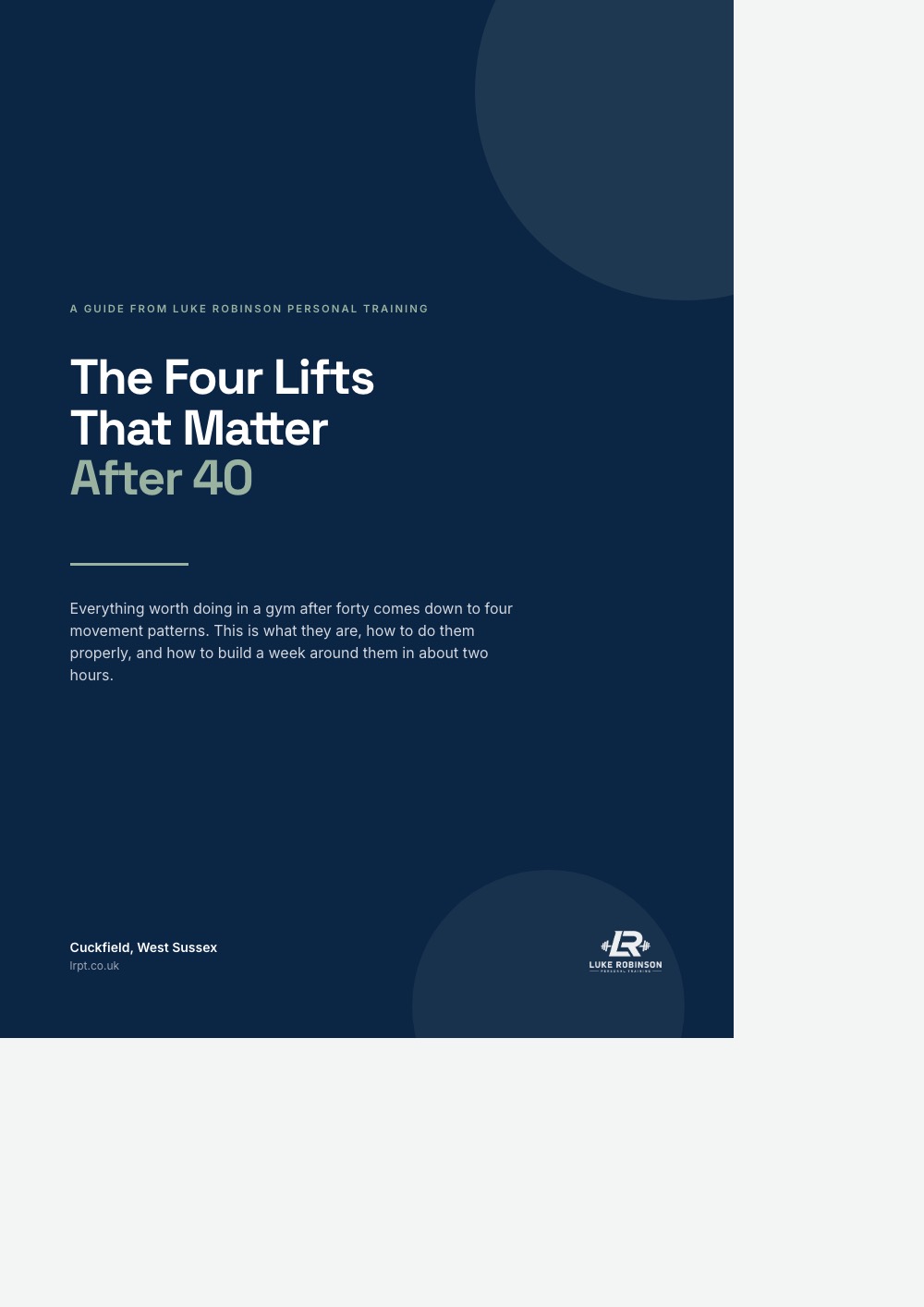
Two free guides, no charge
The four lifts that matter after 40, and how to eat for strength without weighing anything.
Read them freeYou get your plan, and we agree how often you are training and what happens between sessions. Mild soreness a day or two later is normal, especially early. Being unable to walk is not, and it means the session was written badly.
The soreness point is worth expanding on, because people use it as a scorecard. Soreness mostly measures how new something was, not how effective it was. It fades after the first two or three weeks even though the training is getting harder, which tells you it was never a good measure in the first place. Judge a session by whether the weights on your sheet are moving, not by how much you groan on the stairs.
The first two weeks
Week one is learning the patterns. Week two usually feels better than week one, because your nervous system picks things up quickly even before your muscles change. Somewhere in the first fortnight most people notice they are sleeping better and feeling less stiff at their desk. Visible changes take longer, and anyone promising otherwise is selling something.
Between sessions you will have something to do, and it will be realistic. Usually a walking target and one or two simple things to work on. Not a six day programme you will abandon by Thursday.
A few more questions
How long is a session? Typically around an hour, including the warm up and the talking. Shorter sessions can work well if your diary is tight, and we can discuss that on the call.
What if I need to cancel? Life happens, especially with children. We agree the cancellation arrangement up front so it is never awkward later.
Do I need to get fitter before I start? No. That is like tidying before the cleaner arrives. Come as you are.
What if I hate it? Then tell me, and we change it. Nobody sticks with training they dread. Part of my job is finding the version you will actually keep doing, which for most people is not the version they assumed.
If you are in Cuckfield, Haywards Heath or Balcombe and you would rather ask questions before booking anything, that is what the free consultation is for. No pressure and no obligation. You can get in touch here.
Training in Cuckfield, Haywards Heath or Balcombe? Book a free consultation and I will give you a straight answer about what would work for you.
Book your free consultation