Exercise and Menopause: Why Strength Training Earns Its Place in Perimenopause and After
What tends to change through perimenopause and menopause, why resistance training and protein matter, and how to train around symptoms and bad weeks.
 By Luke Robinson, personal trainer in Cuckfield · 8 min read
You are doing roughly what you have always done and your body has stopped responding to it. Sleep is patchier, recovery takes longer, your midsection has changed shape without much change to the scales, and some mornings your joints feel like they belong to someone considerably older.
If you are somewhere in perimenopause or past it, none of that is imagined and none of it is a personal failing. It is also not the end of the story. Strength training is one of the few things that reliably helps across several of those problems at once, and it does not ask you to do more of what already is not working. This is a plain account of what tends to change, why resistance training and protein matter more now than they did, and how to keep training through weeks when you feel dreadful.
First, the thing I am not going to do
I am a personal trainer, not a doctor. I am not going to tell you what to think about HRT, or offer an opinion on which symptoms should be treated and how. Those are conversations for your GP, and they are worth having properly rather than putting off. If your symptoms are affecting your sleep, your mood, your work or your relationships, book that GP appointment and go in with a list. Write things down for a fortnight beforehand if you can, because it is far easier to be taken seriously with specifics than with a general sense that something is off.
What I can talk about honestly is training, food and load management, because that is the part I work on with clients in this stage of life.
What tends to change
Experiences vary enormously and yours may look nothing like the next person's. That said, a few themes come up often enough in my conversations that they are worth naming:
- Body composition shifts. Many women notice fat distribution moving towards the middle, and muscle becoming harder to hold on to, even with no change in habits.
- Recovery slows. A session that used to leave you a bit stiff for a day now leaves you sore for three, particularly if sleep has been poor.
- Sleep gets less dependable. Waking at three in the morning is a very common complaint, and it colours everything else, including your appetite and your willingness to train.
- Joints ache. Stiff hands in the morning, sore shoulders, achy hips. It is common and it is often worse on waking and better once you have moved about.
- Motivation and mood wobble. Some weeks you feel capable and some weeks you do not, and the pattern can feel random.
The instinctive response to most of that is to train less, or to switch to something gentler. I understand why. It is usually the wrong move, because the tissue you lose while you wait to feel better is difficult to get back.
Why resistance training specifically
That is what the free consultation is for. We talk through your goal, your history and what would realistically fit your week.
Resistance training is the only form of exercise that gives your body a direct reason to keep muscle. That matters because muscle is the tissue most at risk during this period, and because it underpins so much else: how much you can carry, how stable your joints feel, how well you tolerate a long day on your feet.
Loading also gives bone a reason to stay dense. Bone is living tissue and it adapts to the demands placed on it, which is why weight bearing and resistance work are so consistently recommended for skeletal health. Oestrogen has a protective role in bone, and its decline is why this conversation becomes more pressing for women around this age than it was a decade earlier. Training is not a substitute for medical management, but it is the part of the picture that sits entirely in your hands.
There is a practical benefit too, and clients mention it more often than the physiology. Lifting gives you something objective to measure at a time when a lot of things feel out of your control. The scales can be unhelpful and unreliable right now. A logbook showing that your squat has gone from eight kilograms to thirty over five months is not open to interpretation.
Protein, without making it complicated
Most women I sit down with are eating less protein than would serve them, usually because breakfast and lunch are afterthoughts and dinner does all the work. If your body is finding it harder to hold on to muscle, the raw material becomes more important, not less.
The practical version, without weighing anything:
- Get a decent source of protein into every main meal rather than loading it all into the evening. Eggs, Greek yoghurt, fish, chicken, beans, lentils, tofu, cottage cheese, whatever you actually like and will keep buying.
- Treat breakfast as a real meal. It is the one most often skipped or reduced to toast, and it is the easiest single fix.
- If you are eating less overall because your appetite has changed, protein is the last thing that should shrink, not the first.
- Sort food out around training days especially. Turning up to a session underfed is a reliable way to have a bad one.
None of that requires tracking software, a meal plan or a subscription. It requires deciding in advance what the protein is going to be at each meal, which takes about ten minutes on a Sunday.
Training around symptoms and bad weeks
This is the part that most programmes get wrong. They assume every week is a good week. Yours will not be, and a plan that only works when you feel fine is not a plan.
What I do instead is simple. Every session has a full version and a reduced version, decided when you walk in rather than a fortnight in advance.
- Good week. Train as written, push the top sets, add weight where it is available.
- Average week. Same exercises, same weights, fewer sets. You keep the pattern and the load without digging a hole.
- Rough week. Cut it to the two or three main movements, keep the weights moderate, be out of there in twenty five minutes. This still counts. It is not a failed session.
- Genuinely awful week. Go for a walk, get some daylight, eat properly, and come back on the next scheduled day rather than writing off the month.
The point of the reduced versions is that they protect the habit. Once a week is missed entirely, the next one is easier to miss, and that is how three months disappear. Turning up and doing a smaller version keeps the thread intact, and the thread is worth more than any individual session.
A few specifics that help. If you run hot, train in a cooler part of the day and do not be precious about longer rests between sets. If your joints are stiff in the mornings, a longer warm up is not wasted time, it is the price of a good session. If sleep has been broken, expect strength to be down that day and treat that as information rather than failure. This is exactly the sort of thing I adjust week to week when I am coaching someone one to one, because no written plan can see how you slept.
What a sensible week looks like
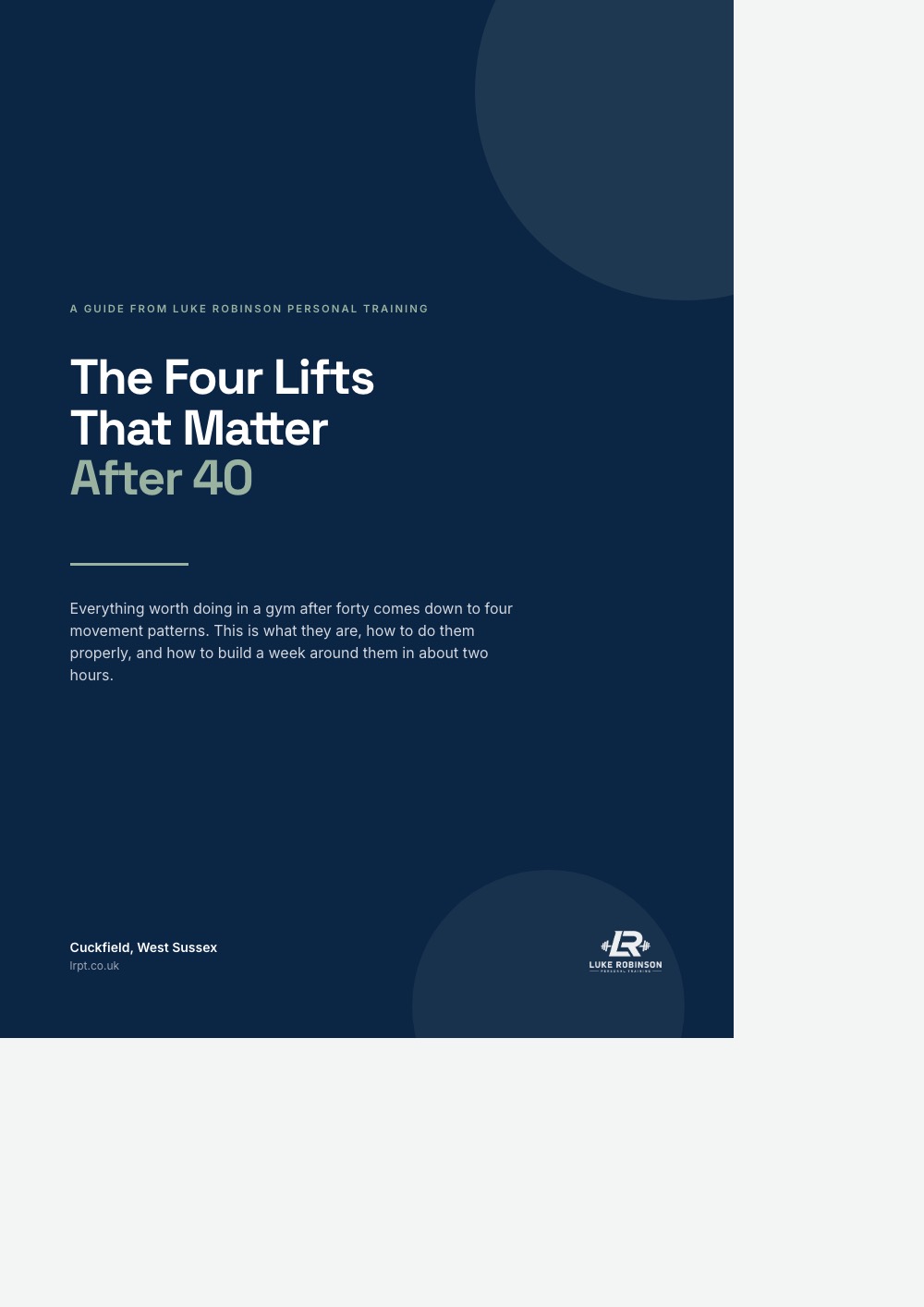
Two free guides, no charge
The four lifts that matter after 40, and how to eat for strength without weighing anything.
Read them freeTwo full body strength sessions a week is a genuinely effective starting point, and it is realistic for someone with a job and a family. Three is better if it fits without stress. Each session covers a squat pattern, a hinge, a push, a pull and something carried or held, because that combination trains the whole body without needing eleven exercises.
Around that, walk. Walk more than you think is worth counting. It is good for your mood, your sleep and your recovery, and it costs you almost nothing in terms of fatigue. Add whatever else you enjoy on top, because enjoyment is most of the reason anything continues past March.
What I would not do is add a lot of high intensity work on top of poor sleep and a demanding job. It tends to make recovery worse without adding much, and it is often the thing that leads to a burst of enthusiasm followed by six weeks off.
Expectations, set honestly
Strength will improve. That happens reliably and it is the most satisfying part to watch, because it is measurable and it transfers straight into daily life. Body composition changes are usually slower than they would have been in your twenties, and pretending otherwise would just set you up to feel like you had failed at something that was never on offer.
Sleep, mood and hot flushes are more variable. Some women find that training helps a good deal, some find it makes little difference to those specific symptoms. That variability is exactly why the medical side of the conversation belongs with your GP rather than with me.
What I can say with confidence is that being stronger makes everything else easier to carry, in both senses. Nobody I have worked with has regretted getting stronger.
If you are in Cuckfield, Haywards Heath or Balcombe and you want to talk this through with someone who will not be weird about it, the first step is a free consultation with no obligation. We talk about where you are, what your weeks actually look like, and what would sensibly fit into them. You can find out more about me and how I work, or send me a message and we will sort out a time.
Training in Cuckfield, Haywards Heath or Balcombe? Book a free consultation and I will give you a straight answer about what would work for you.
Book your free consultation